Making room in Morocco's lineup: a conversation with Ikram Jabbari
On Morocco's Atlantic coast, the fishing village of Imsouane pulses with an energy unlike anywhere else. Here, where traditional blue boats bob in the harbor and the call to prayer echoes across endless point breaks, Ikram Jabbari has found her rhythm.
In a lineup that has traditionally been masculine, she's part of a growing movement of Moroccan women claiming their space and rewriting the rules—blending tradition with global influence, proving that the future of surf is as diverse as the places it calls home.

Known locally as "Magic Bay," Imsouane boasts what many consider Africa's longest surfable wave—a dreamy right-hander that can stretch for over 600 meters, offering rides that last up to two and a half minutes. It's the kind of wave that draws longboarders from around the globe.
This small village, nestled between Essaouira and Agadir, represents something rare in today's surf world: authenticity. While tourism has grown, Imsouane has preserved its soul—the morning fish markets, the traditional tagines served overlooking the point, the genuine warmth of a community that has welcomed the surf world without losing itself.
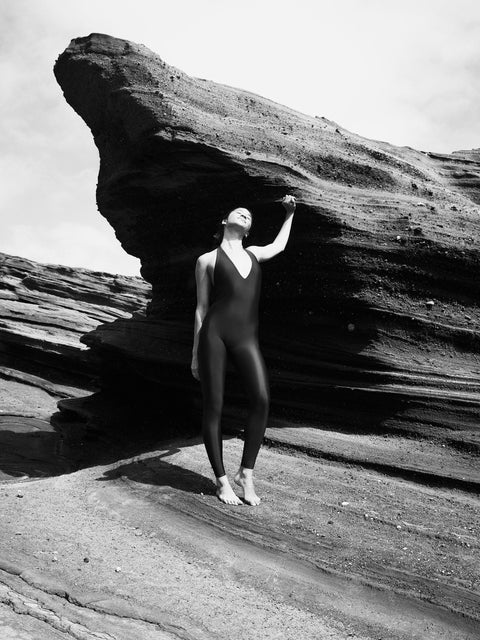
Issam Naamalik of Classic Surf Studio captured these stunning images of Ikram in Imsouane wearing our Keramas hooded rashguard and Ensenada high waisted briefs, and Trestles springsuit, and in Bali wearing our Malibu swimsuit and Newport bikini top paired with Bondi briefs, where she spent a season chasing tropical lines this summer.
 We caught up with Ikram to talk about life in the magical corner of Morocco that she calls home, the intersection of surf and style, and what it means to ride waves in a place where tradition meets transformation.
VSC: What drew you to Imsouane?
IJ: I grew up in a city called El Jadida.
Honestly, I was just trying to discover the South. I had no big plan, I was just going with the flow, and then I arrived in Imsouane. The magic of this place completely surprised me. It was peaceful, raw, beautiful… something about it just felt right.
I found myself wanting to stay longer, so I started looking for a job just so I could stay here, surf, and enjoy the vibe.
VSC: You've returned to Imsouane after spending the summer in Bali. How do these two places shape your approach to surfing and life?
IJ: Imsouane taught me to slow down in a good way. It isn't just a wave, it's a teacher. It shapes you to feel every turn, to surf with intention, to find joy in the smallest peelers, and to share waves like you share bread. That place grounded me.
Then Bali came with the fire, it's fast, alive, and full of energy. The energy isn't just in the waves, it's in the people, the culture, the hustle. It pushed me to adapt, to find my space in the chaos. It sharpened my edge, taught me balance in the middle of noise
 VSC: Imsouane has this incredible reputation for having one of the longest waves in Africa. What's it actually like living and surfing here every day? Does the magic ever wear off?
IJ: Living and surfing in Imsouane every day feels like being part of something ancient and simple. The wave is long, yes, but it's the way the whole bay moves that makes it special. It teaches you to slow down and enjoy the ride.
Some days are glassy and perfect, others soft and small, but even then, you paddle out, see a familiar face, share a laugh, and it's enough. It's not about chasing the best wave. It's about being there, feeling the tide shift, the wind change, and the golden light hit the cliffs.

VSC: Morocco's surf scene has grown dramatically, but women surfers are still breaking new ground. What's been your experience as a female surfer here, and what changes have you witnessed?
IJ: I grew up around the ocean, but where I'm from, it was mostly boys surfing. It wasn't really common to see girls in the water unless it was just for a swim. Surfing felt kind of distant, like something that wasn't really for us.
But when I came to Imsouane, I started seeing a few girls out there surfing, and that honestly motivated me to get in the water and try. I've always felt connected to the ocean, I had that ocean awareness from growing up near it, but seeing other women surfing helped me imagine myself doing it too.
I've been surfing for about three years now, and since then, I've seen more and more girls showing up. The energy is shifting. There's more support, more confidence, and it feels like something real is growing.
VSC: You both surf and model—how do these two worlds complement each other? Has your experience in modeling influenced how you approach surfing, or vice versa?
IJ: I work at a surf shop. But surfing and modeling are passions I try to keep close. With my current job, I get to stay in that world, surrounded by waves, boards, and creative people. It keeps me inspired and gives me the freedom to do what I love whenever I can.
Surfing and modeling may seem different, but they actually feed into each other. Surfing taught me confidence, presence, and how to feel comfortable in my own skin, and that shows up in front of the camera. Modeling, on the other hand, has made me more aware of movement and expression, which flows into how I surf. Both are about feeling something and expressing it just in different ways!

VSC: As someone who spends so much time in the sun, how do you keep your skin healthy, and what advice would you give to other surfers?
IJ: When you're in the sun almost every day, you have to take care of your skin. I try to keep it simple and consistent. I use zinc and sunscreen every time I surf non-negotiable.
But honestly, we do it the Moroccan way too. I love going to the hammam from time to time, nothing beats that deep scrub to get rid of all the salt and dead skin. And I use traditional masks, like ghassoul or natural oils, to keep my skin nourished.

Representation ripples outward
Ikram's story distills something we believe deeply: visibility changes everything.
She grew up near the ocean, felt its pull her whole life, yet surfing seemed like something that "wasn't really for us." It took seeing a few women in the lineup at Imsouane to unlock what was already there.
"Seeing other women surfing helped me imagine myself doing it too."
That's the quiet power of representation. It doesn't hand you skills or guarantee success. It simply opens a door you didn't know existed—and lets you walk through it on your own terms.
Three years later, she watches the same thing happen around her. More women showing up, more confidence in the water. She became the representation that once changed her perspective, now changing it for others.
This is how culture shifts. Not through grand declarations, but through presence. Through paddling out, claiming their space, and making it easier for the next one to imagine themself out there too.